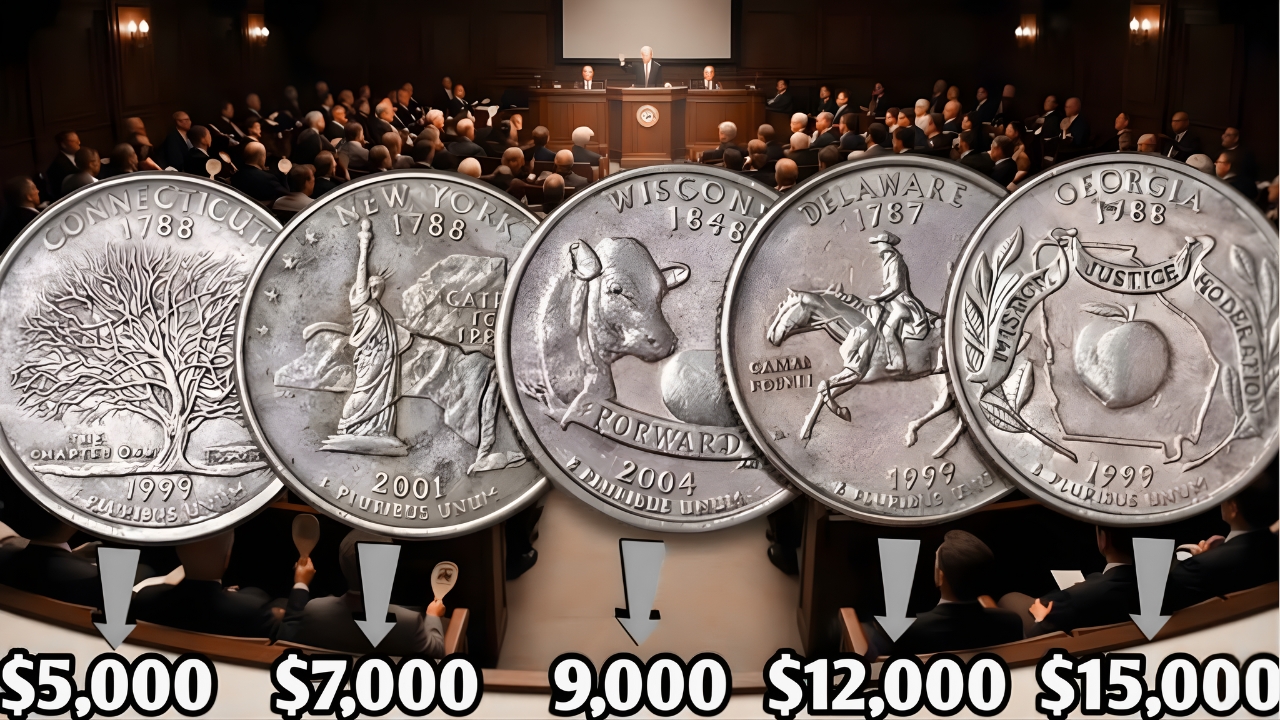
Washington quarters are so common in everyday life that most people barely give them a second look. They pass through hands at grocery stores, gas stations, and vending machines without a thought. Yet hidden among millions of ordinary coins are a handful of rare pieces that collectors eagerly chase. Some of these quarters, thanks to low mintages or unusual minting mistakes, can be worth hundreds or even thousands of dollars.
Originally introduced in 1932 to celebrate the 200th birthday of George Washington, the quarter designed by John Flanagan quickly became a permanent part of U.S. currency. Over the decades, it has seen design updates and metal changes, but the basic look has remained familiar. That familiarity is exactly what makes rare examples so exciting. They look almost identical to regular coins, yet a small detail can make all the difference.
For collectors, these quarters represent more than spare change. They are small pieces of history that tell stories about the Great Depression, wartime production, and evolving minting technology. Knowing what to look for can turn an ordinary coin hunt into a surprisingly rewarding hobby.
What Exactly Is the Washington Quarter and Why Do Some Become Valuable
The Washington quarter is a 25-cent coin that has been in continuous production since 1932. While billions have been struck, not all were made in equal numbers or under perfect conditions. Some years saw extremely low production, while others produced coins with errors that slipped past quality control.
Value usually comes down to three key factors: scarcity, condition, and uniqueness. A coin with a tiny mintage is naturally harder to find. A coin in pristine, uncirculated condition is more desirable than one worn smooth from decades of use. And coins with noticeable errors, such as doubled lettering or incorrect metal, often attract strong collector interest.
When these traits combine, prices can climb quickly.
9 Rare Washington Quarters Collectors Are Searching For
Several Washington quarters consistently stand out in the market due to their rarity or unusual features.
The 1932-D quarter is one of the most famous key dates. Struck during the Great Depression, only about 436,800 were produced, making it a cornerstone for serious collectors. The 1932-S from San Francisco is similarly scarce, with just over 400,000 minted.
Error coins add another layer of excitement. The 1943-D doubled die obverse shows clear doubling on the date and lettering, visible even without advanced tools. The 1950-D over S mintmark features an overpunched mintmark where one letter sits on top of another, a detail that specialists love to spot.
The 1955-D doubled die quarter is another standout, known for strong doubling in the motto and date. Transitional planchet errors, like certain 1964 quarters struck on the wrong metal, are also highly prized because they were never meant to exist.
Proof-only issues such as the 1970-S quarter, typically found only in collector sets, are scarce in everyday circulation. Meanwhile, the 1982 quarter missing its Philadelphia mintmark and the 1983 doubled die varieties prove that even modern coins can be surprisingly valuable.
Together, these nine coins have sold for impressive sums, with top-condition examples pushing total values into the tens of thousands of dollars.
Silver Content and Metal Changes Matter
Quarters minted before 1965 were made from 90 percent silver, which gives them intrinsic value even if they’re not rare. As silver prices rise, these coins become more attractive to both collectors and investors.
After 1965, the U.S. Mint switched to copper-nickel clad composition. Most of these are worth only face value, but errors or special issues from this era can still bring strong premiums. Understanding the metal content is a quick way to separate ordinary coins from potentially valuable ones.

How to Start Your Own Coin Hunt
Searching for valuable quarters doesn’t require expensive tools. Many collectors begin with pocket change, coin rolls from banks, or old jars tucked away at home. A simple magnifying glass helps spot mint marks and doubling. Checking dates carefully is key.
Handle coins gently by the edges and store promising finds in protective holders. Never clean coins, as this can damage the surface and reduce value significantly. If you suspect you’ve found something rare, consider having it evaluated by a professional grading service.
Final Verdict
Rare Washington quarters prove that hidden treasures can still exist in everyday circulation. From low-mintage 1930s issues to modern minting errors, these coins combine history, scarcity, and a bit of luck. With patience and a sharp eye, collectors may discover that a simple quarter can be worth far more than twenty-five cents.